Partitioned heat conduction (complex setup)
This tutorial is the advanced version of the “partitioned heat conduction” tutorial, showcasing more advanced features and geometries.
Note: Get the case files of this tutorial
, as continuously rendered here, or see the latest released version
(if there is already one). Read how in the tutorials introduction
.
Setup
This case is an advanced version of partitioned-heat-conduction. Some advanced features offered by this case:
- Geometries may be chosen arbitrarily. One possibility is to use a circle and a rectangular plate with a hole, but you can also provide your own geometry, if you want.
- You may combine arbitrary mesh resolutions at the coupling interface.
- Nearest projection mapping is used.
- The Dirichlet and Neumann participants may be swapped arbitrarily.
- The exchanged temperature is still scalar valued, but the heat flux is vector valued.
- You can decide to use a time dependent heat flux and right-hand side to make the problem more challenging.
Configuration
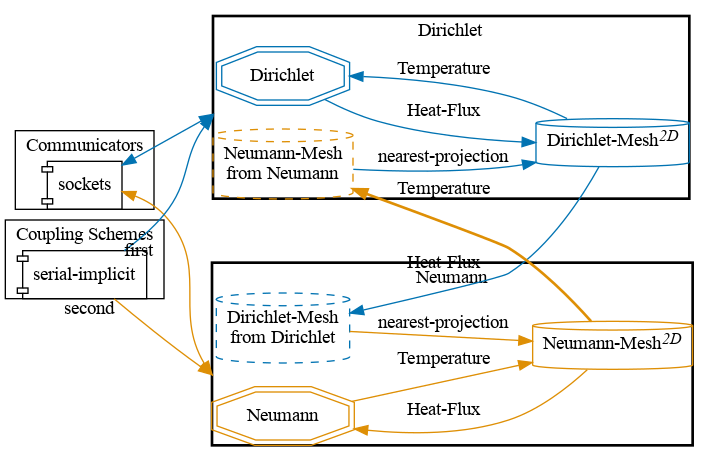
preCICE configuration (image generated using the precice-config-visualizer ):
Available solvers and dependencies
See partitioned-heat-conduction, only fenics is provided as a solver.
Running the simulation
See partitioned-heat-conduction. The additional featured mentioned above can be activated via command line arguments. Please run python3 solver-fenics/heat.py --help for a full list of provided arguments.