Fluid-structure-electricity coupling for flexible wave energy converters
Inspired by the streamlined bodies and compliant fins of aquatic animals, a new generation of adaptive, flexible materials has gained significant attention in the development of Wave Energy Converters (WECs) over the past decade. These materials possess the distinctive ability to deform in response to external loading, allowing WEC structures to adapt dynamically to the marine environment. Incorporating flexibility into WEC design offers several advantages, including improved survivability, enhanced hydrodynamic performance, and the potential for integrated energy harvesting mechanisms.
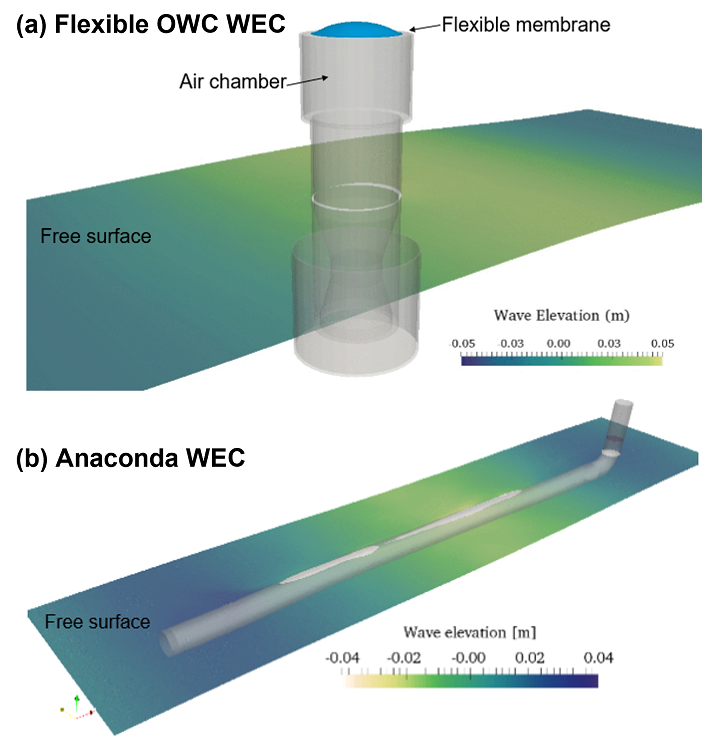
In our EPSRC-funded project “Bionic Adaptive Stretchable Materials for WEC (BASM-WEC) ” (EP/V040553/1), we aim to develop a comprehensive numerical and experimental framework to support the reliable design, analysis, and manufacture of state-of-the-art adaptive stretchable materials for wave energy applications. To achieve these goals, we have developed a hydro-elastic coupling toolkit based on OpenFOAM, CalculiX, preCICE, and an in-house electricity generation module. This integrated framework provides a robust pathway for specifying detailed material properties tailored to the functional requirements of flexible WEC systems. Using this tool-chain, we conduct fluid–structure–electricity interaction simulations to investigate the behaviour and performance of a range of flexible WEC concepts employing dielectric elastomer generator (DEG) membranes, including flexible Oscillating Water Column (OWC) devices and flexible tubular WECs. Learn more
- Prof. Qing Xiao
CFD & FSI-RG, University of Strathclyde, UK